Folded from a
real family's day.
Origami direction, GPT-5.4 Image 2, expressive faces — locked per your call on the anchor comparison. This is the production plan: the full five-scene journey, what each scene proves about OiMy specifically, and one consistent visual signature for Oi that carries the "eye of Oi" motif from the live site into paper form.
Every scene now earns its place by demonstrating one real thing OiMy does — not "family moment #N."
Five scenes, five distinct differentiators (memory, mental-load coordination, in-the-moment coaching, presence-without-a-screen, emotional steadiness), and one single, literal, unchanging visual object for Oi that appears — same form, same object, every time — in every single scene, tying back to the actual eye-of-Oi asset already live on the site.
00The Oi signature — one object, unchanging (revised per Bharath — no more disguises)
Before touching scenes, I pulled two actual frames from the live hero-eye-loop.mp4 (the asset already running top-right of the v10 hero) rather than working from memory. What's actually there: a radial iris — fine linework strands flowing outward from a dark central void like brushed fur or flame, a white-hot ring immediately around that void, warm gold/amber dominant, a cool blue-teal bleed at one edge, on black. It reads as alive without being a face — attentive, not anthropomorphic.
The origami translation — call it "the Sunburst": a single small folded-paper radial rosette, roughly hand-sized, triangular paper facets fanning outward from a dark center like the rays of a folded sun, a bright gold highlight ring around that center, one edge folded in a cooler teal-grey tone as a quiet nod to the original's blue bleed. It is never a character — no face, no body — and, per your correction, it is never disguised as scene furniture either. It is always literally itself: the same folded object, same silhouette, same palette, appearing directly in frame in every scene — sitting on a counter, resting on a garden wall, beside a workbook, on a windowsill near the dinner table, hovering above the roofline at hero scale. What changes is only its size and position within the composition (closer, farther, bigger at the finale as the camera pulls back to the whole house) — never its form. A viewer should be able to spot "there's Oi" at a glance in every scene without having to decode a new object each time.
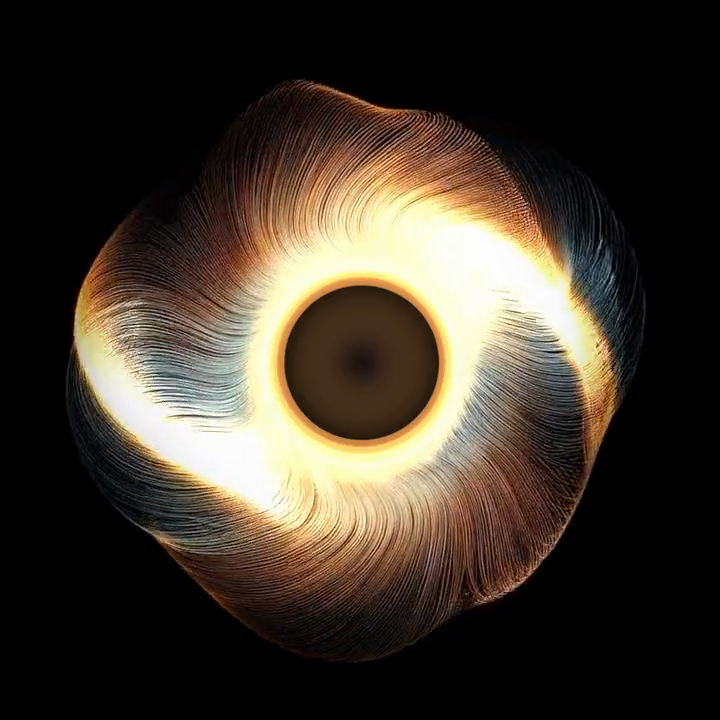
Real frame pulled from the live hero-eye-loop.mp4 — the actual asset, not a description of it
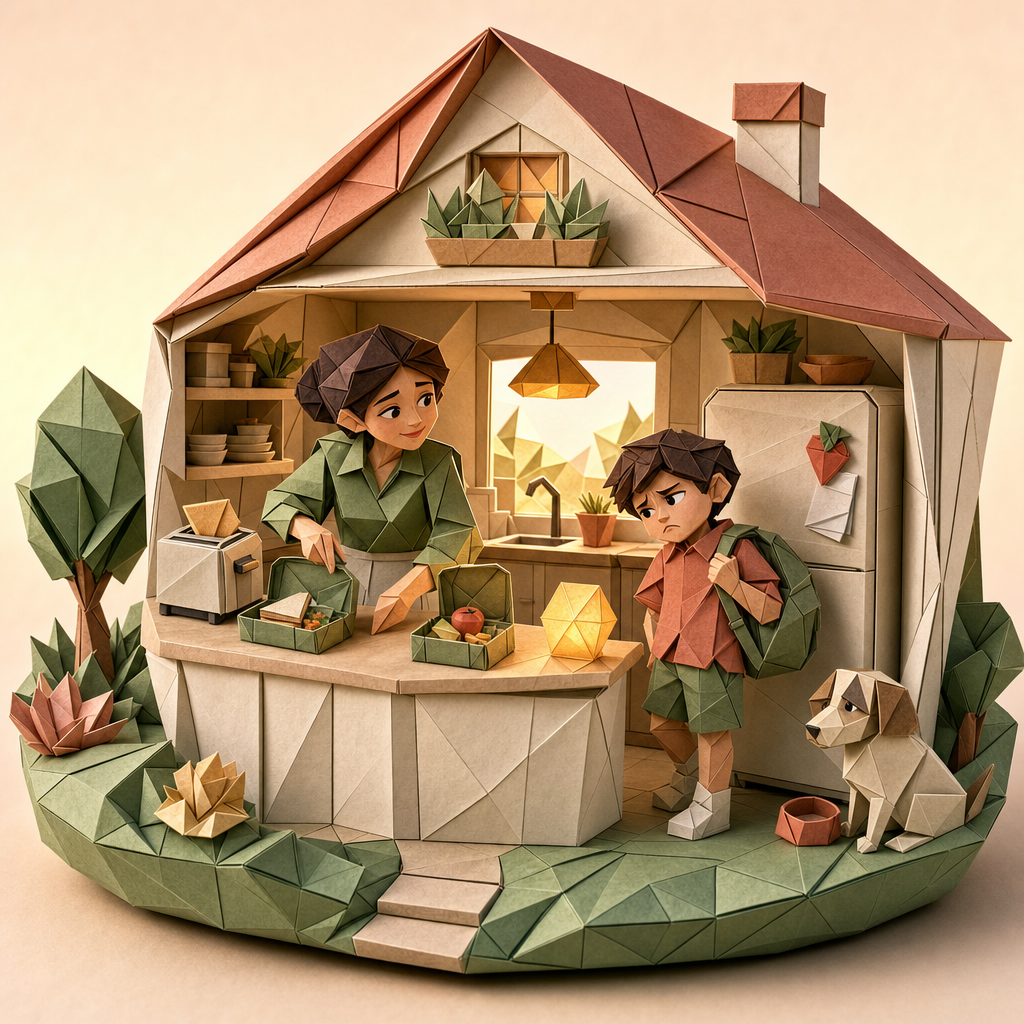
Scene 1, already generated and anchor-approved (GPT-5.4 Image 2, origami + faces) — the golden faceted object on the counter is the closest existing draft of the Sunburst
Scene 1's already-approved anchor shows a golden faceted lantern-like object on the counter — close, but built as a little lantern/vessel rather than an explicit radial rosette. Recommended refinement (light touch-up, not a full regeneration): sharpen it toward the exact radial-ray-around-a-dark-center form described above, since this exact object now needs to be pixel-for-pixel copyable into scenes 2–5 rather than just family-resembling.
01What's actually distinctive about OiMy — the five differentiators driving the scenes
Pulled from the platform's own architecture docs and skill library (oimy-skill-engine/BACKGROUND.md, the 81-skill manifest set, the live hero copy), not invented for this brief:
| Differentiator | Where it actually lives in the product |
|---|---|
| Remembers the small stuff | Family-memory + profile synthesis — DEEP_PROFILE built from real conversation history, not a form you fill out once |
| Lifts the mental load | A dedicated mental-load skill plus carpool / appointments / calendar-manage / commute-check — coordinating threads across school, work, and home without being asked each time |
| Coaches in the moment, invisibly | Real developmental-psychology frameworks (Siegel, Kennedy, Delahooke, Markham) made directive rather than referenced — the voice doctrine's actual goal is "she gets it," never "she knows a lot" |
| Present without being a screen | Voice-first interaction (TTS/STT, voice-call skill), on-device routing for low-latency presence — the product's own architecture bet is specifically against "open an app" friction |
| Steady in hard moments | The live hero copy's own closing line — "on the hard days, someone steady beside you" — elder-checkin, symptom-triage, emergency-family; the emotional/trust layer, not just logistics |
02Budget tier — Standard, 5 scenes, Architecture A (unchanged reasoning, reconfirmed)
Reconfirming rather than re-deciding: the video transcript's own creator called 4 scenes a cost sweet spot, and that's a fair default for a generic brand. It doesn't fit here — the five differentiators above are genuinely distinct and each needs its own beat; compressing to four forces two of them into one scene, which directly undercuts the "each scene earns its place" instruction. 5 scenes, Architecture A (continuous forward glide), stays the right call — same as the original clay proposal, now built on differentiators instead of a generic "day in the life."
03Brand kit — the origami system (validated across 4 real generations already)
Lighting: single-source directional sunlight, hard-edged faceted highlights along fold ridges, flat clean color blocking within each plane, minimal gradient — a studio-lit paper diorama, not a moody one. Faces: naturalistic soft-shaded expression grafted onto the same faceted-paper body language everywhere else — confirmed working well in GPT-5.4 Image 2 specifically (Nano Banana Pro's face/body seam was the reason GPT-5.4 was the right pick, not just a coin flip).
04The journey — five scenes
Nothing forgotten this morning.
Demonstrates: remembers the small stuffOi already knew about the permission slip, the lunch a fussy eater will actually finish, the early pickup — before anyone had to ask.
In the diorama (already generated, approved): folded-paper house opened like an origami box, warm kitchen inside, parent packing lunchboxes with a warm close-mouthed smile, kid mid-whine with a scrunched brow and a half-slung backpack, a folded strawberry magnet pinning a paper permission slip to the fridge, a small folded dog at its bowl.
The Sunburst: sits directly on the counter beside the lunchboxes, in plain sight, at roughly grapefruit scale — recommend the light touch-up described in §00 so its exact silhouette becomes the fixed template scenes 2–5 copy verbatim.
Scattered all day. Nothing dropped.
Demonstrates: lifts the mental loadPickup moved, the ride's arranged, the appointment's confirmed — Oi holds the day's moving pieces so no one has to carry the whole map in their head.
In the diorama: the camera's one pull-back — a folded-paper neighborhood: a school with a striped awning and a tiny origami playground, a fold-out desk under a paper tree where a parent works, the house between them, all three connected by a thin gold-threaded paper path across folded hills.
The Sunburst: the same object, unchanged, resting directly on the folded path at its midpoint between the three places — recognizable at a glance as the exact thing that sat on the counter in scene 1, not a new device standing in for it.
The tears before the times tables.
Demonstrates: coaches in the moment, invisiblyWhen frustration hits, Oi helps you meet the feeling first — the fractions can wait a minute.
In the diorama: the folded kitchen table again, afternoon light, homework spread out and one sheet slightly crumpled, kid's face showing real frustration — furrowed brow, welling eyes, not a tantrum, just stuck — parent kneeling down at the kid's eye level rather than standing over them (the "connect before correct" beat, made visible in body language alone).
The Sunburst: the same object again, sitting on the table beside the workbook — no redesign into a "desk lamp," just itself, placed closer to the two of them than in any other scene, which is what makes this beat feel intimate, not a different prop.
Dinner nobody had to plan.
Demonstrates: present without being a screenOi remembers who's allergic to what and who won't touch mushrooms — so the table is just the table again.
In the diorama: the same table transformed — dinner set for four under folded paper light, steam rising off warm folded food, the whole family genuinely present with each other, faces turned toward one another, not a screen in sight anywhere in the frame — the point is what's absent as much as what's there.
The Sunburst: the same object, unchanged, placed on a windowsill or side shelf a little apart from the table — not on it, not competing with the family for attention, but still clearly in frame and still clearly itself. Presence expressed through where the object sits, not through redesigning it into a ceiling fixture.
Room to be a family.
Demonstrates: steady in hard momentsOiMy holds the running of the house, so the evening — and the hard days — are steadier. → Meet Oi
In the diorama: the full folded-paper house from outside, night, one warm window glowing, a curl of folded-paper chimney smoke, the folded garden quiet below.
The Sunburst: the identical object, not a redesign — simply larger and closer in frame as the camera pulls back to the whole house, hovering upper-right above the roofline exactly where the real eye-of-Oi asset sits on the live hero today. This is the payoff of never having disguised it: by scene 5 a viewer has already seen this exact object four times, so its arrival at hero scale reads as "there it is, bigger" — recognized instantly, not introduced for the first time.
05Honest production risks — named, not buried
--image reference passed into every subsequent still in the same batch. Neither OpenRouter image model has a confirmed, tested mechanism for that in this project yet — each of the five stills would currently be a fresh generation from a detailed but independent prompt. In practice this likely means "the same family, the same house, the same Sunburst" by description, not pixel-locked identity. Recommended next step before generating scenes 2–5: one small test — pass scene 1's finished image back into a scene 2 prompt as a reference input and see whether GPT-5.4 Image 2 actually holds the parent/kid's likeness and the house's exact geometry. Cheap to test, expensive to discover the hard way after five full generations.06Spend estimate
| Item | Count | Real / estimated cost |
|---|---|---|
| Scene stills (GPT-5.4 Image 2, OpenRouter) | 4 new + 1 already generated | Real: ~$0.24 each, confirmed via billing |
| Face/consistency re-roll buffer | +2–3 | ~$0.24 each |
| Video legs (Higgsfield Seedance 2.0, Architecture A) | 5 (dive + 4 continuous legs) | Estimated, unverified: ~$0.50–$1.20 each — confirm against real Basic-plan rate before spending |
| Stills total | ~$1.70–$2.20 | |
| Motion total (rough) | ~$2.50–$6.00 (unconfirmed) | |
| Planning ceiling | ~$5–$10 total — cheap in absolute terms either way; the open item is precision on the motion number, not affordability | |
Mobile tier unchanged from the original recommendation: mobile encodes (720p siblings, zero extra generation cost), crop-safe framing baked into every prompt.
07If you say go
- Quick consistency test: feed scene 1's finished still back into a scene-2 prompt as a reference image, confirm GPT-5.4 Image 2 actually holds character/house identity across generations before committing to all four remaining stills.
- Optional light touch-up on scene 1's Sunburst lantern to lock its exact silhouette (radiating facets around a dark center) as the template for scenes 2–5.
- Generate scenes 2–5 stills, each reviewed individually before moving to motion.
- Confirm real Higgsfield Basic-plan per-clip cost, then generate the 5 Architecture-A video legs, each starting from the previous leg's actual last frame.
- SSIM seam QA (≥0.90), encode, assemble as
oimy-landing-v11-*.htmlalongside v10, Playwright-sweep desktop + mobile.